
Inside IM8's $1B Raise from General Catalyst
& How the true cost of the capital tells us the real story

I know I know I know. Drew this is old news wahhh why did you wait so long to write abou- shutup
I am busy and I have a JOB. Honestly I’ve also completely lost control of my calendar lately so if anyone has any tips for that lmk.
ANYWAYS - yes, IM8 ($PRE) raised $1B in funding from General Catalyst.

But as many of you finance geniuses felt the need to point out to me while I was on vacation last week, no - obviously this was not a $1B to the company equity sort of raise.
Ok, fine. So what kind of raise is this? Why would they do it? What’s the benefit? What’s the cost of this capital? and what does that tell us about IM8 from a highly sophisticated institutional investor?
I am here to answer all of your questions my sweet sweet reader. Don’t you worry.
Let’s get into it
What is this financial instrument?
It’s customer acquisition financing from General Catalysts’ Customer Value Fund. This instrument is basically structured credit. Its the securitization of payments from future customers.
Let’s take a step back.
What’s a security? A security is an asset.
So securitization just means pooling together assets, which creates in itself a new asset - which is a basket of assets.
It’s a bit like a mortgage backed security, you know the kind that blew up the economy yeah that kind. in 2008, the banks put together a bunch of mortgages (e.g., securitized) into on basket of mortgages. Each of these mortgages generates income, but together they are a ~security~.
The mortgages in THIS example of the funding from GC to IM8 are IM8’s customers. General Catalyst is underwriting the future stream of income from IM8’s customers. IM8’s customers are now a security.
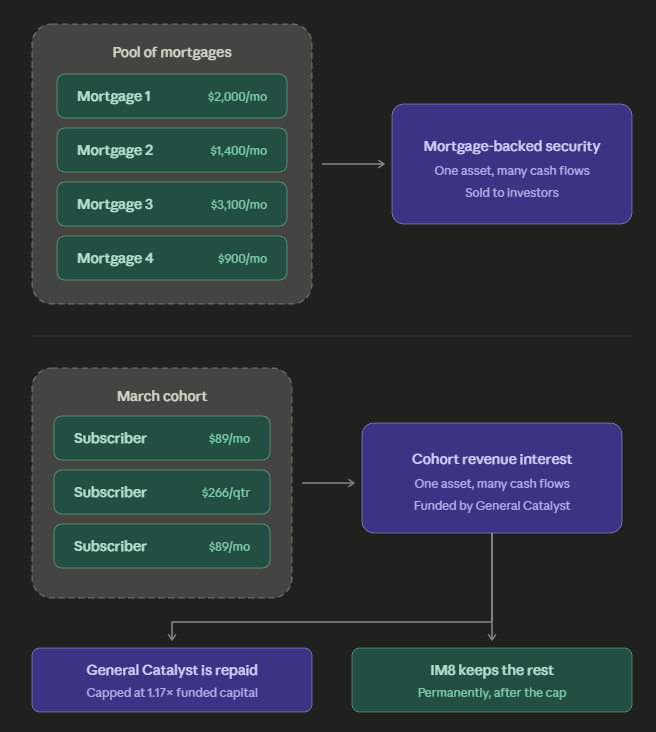
Here’s the difference. IM8’s future customers don’t exist yet, and they’re not contractually obligated to pay the way you are a mortgage. This introduces risk into the payback, but in this case GC is actually the one carrying that risk. If cohorts don’t get paid back, they lose the 70%. IM8 loses their 30%; its basically a risk transfer with a capital premium. More on that later.
TLDR; its a structured credit instrument that we would generally refer to as revenue based financing. Or MCA. It’s Non recourse, meaning GC can’t do much if the customers never pay back.
How it Works
Here’s an example with IM8’s real numbers.
Oversimplifying here, it goes something like:
IM8 plans marketing spend of $25m (1Q26 S&M expense was $20m)
GC gives IM8 $17.5m (70%)
IM8 buys 57,377 customers at their $305 1Q26 CAC
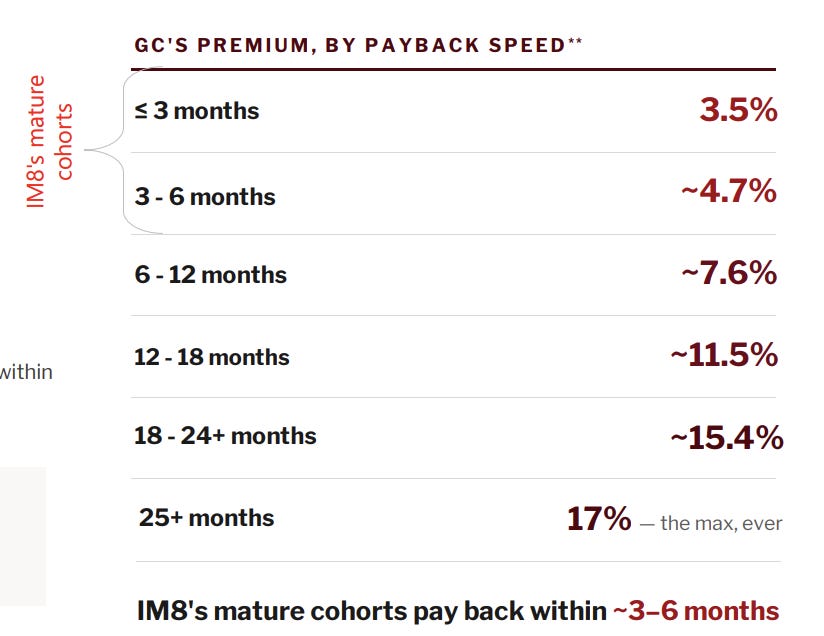
Assuming those customers pay for themselves after 4.5 months, GC gets the $17.5m returned, plus 1.047x the amount, or in this case another $833k. or $18.32m
THEN, IM8 keeps everything after that
That premium of 1.047x could change if IM8’s cohorts start to take longer to pay back. IM8 claims they won’t but it could get as high as 1.17x if the cohorts took 25 months to pay back. Never higher. We can reasonably assume in my view a 6mo payback period for the near and medium term future.
Why Would IM8 Elect to do this?
Typically you would just see a company raise some equity if they were trying to blitzscale. The problem is PRE 0.00%↑ stock is unbearably cheap. There’s a million reasons why this stock is STILL mispriced, but you want to use equity when the stock price is high, not low.
Typically, public companies with beat up valuations are not performing well. And they might be forced to use equity anyways (sell low) - so it’s highly interesting that such an undervalued company would even be eligible for this financing.
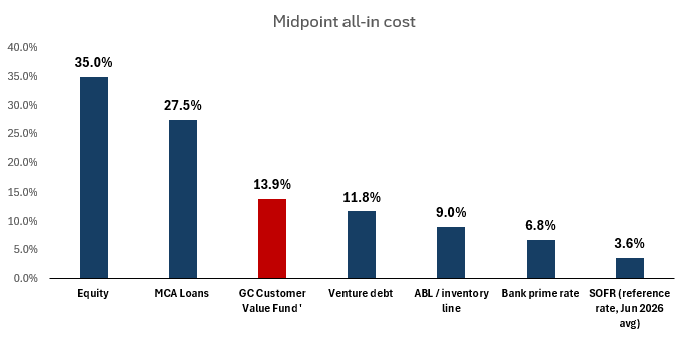
So basically, its cheaper than selling equity, its more flexible than venture debt. here’s how the cost of this capital shakes out against some of the other alternatives. Don’t forget about this cost of capital this is super important later i swear im almost there.
ok fine, we understand why they wuld do this - but that begs the question
How is IM8 able to do this?
It seems here as though that im8s customers are so strong that they can basically securitize them and sell the receivables on the open market. its actually quite a creative capital structure idea.
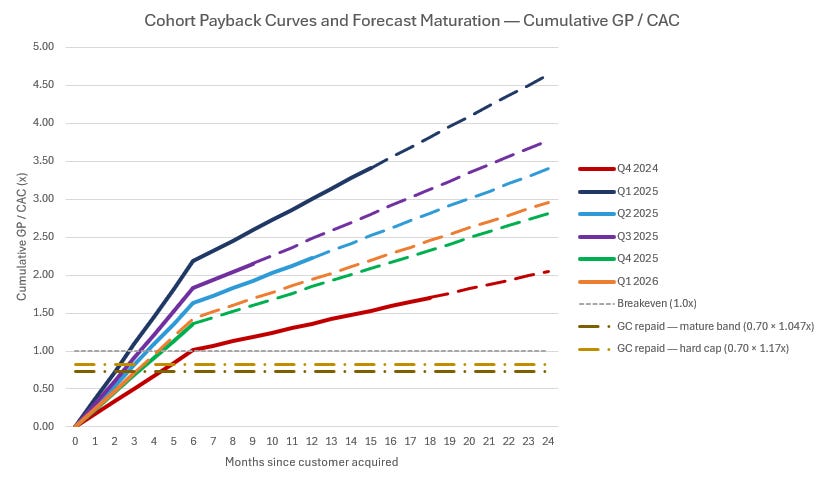
Their cohorts can typically pay back in 6mo, and then they can pay the premium of up to 1.047x, which at 3-6mo payback is avg 13.9%. So then those cohorts pay back, pay the GC premium, and then continue to pay im8. I’ve forecasted out their LTV:CAC based on what data we have and we can even see the most recent cohorts paying back around 3x, which at this scale is seriously impressive.
But the difference is this isn’t a typical MCA or cost. Anyone can go get an MCA, but it costs a ton, potentially even closer to equity.
That said….as you all know there is a lot of confusion around this name and to be honest im not sure this deal helped. I get it…and it was smart…but its just another complicated explanation around pre.
The Cost of Capital
This is the truly interesting part. Im making some key assumptions here including a constant 4.5mo payback and consistent draw downs of the capital. And if you’re still with me you’re a dawg.
A deal like this is a pricing event in some ways; where GC is saying the cost of capital is 13%. In reality this is a lot more complicated but directionally this feels right and that’s not a very high number - it tells me that after 6mo of transaction level due diligence (iris does this btw) that GC feels really quite comfortable with what they’re underwriting here…to the tune of a billy.
Interestingly, as with MCAs, the faster the cohorts payback - technically these willl be the most expensive cohorts. The longer it takes to pay back the lower the CoC.
I will be looking for dislcosure of the actual terms of the deal in upcoming filings.
What this means for the company & my investment thesis.
I’ve still not sold a share. I got in at $12 with a meaningful investment and PRE remains my largest individual holding. I don’t fully know why they felt this was something they felt they needed to do, but I understand mathematically why it is compelling. The questions I want answers to have to do with the path to profitability.
General Catalyst has given me extra comfort with the quality of IM8s revenue, but they are underwriting the gross profit of the cohorts - not the EBITDA of the business. Those are two very different things. This instrument adds interest expense to a P&L that is not generating positive earnings, and the risk lies in management actually a) executing on continuing to grow the business on a unit-economic profitabile basis and b) not fucking up profitability with below the line expenses.
All in all, as an equity holder this is obviously a positive and savvy move from IM8. That said, I do think it introduces some questions for a name that doesn’t need more questions right now. The stock is trading extremely cheap - which is great - but overhangs can sort of kind of become permanent. At which point a value driven thesis isnt clever its just naive. I’ve been in the stock for almost a year now and I honestly cannot believe its not up to $30 by now, which makes me feel like this whole thesis may take a bit longer than i underwrote to pan out.
In any event, I remain bullish and the General Catalyst deal is a vote of confidence from some of the best investors in the game. I continue to believe that this company will continue to perform (as I’ve seen this movie a hundred times) and I am hopeful that the market will come around and re rate accordingly, though I think now I am recognizing that that may take some time. For these reasons, I am likely a buyer on any dips to $17 or below.
Disclaimer
This newsletter is for informational and educational purposes only. It is not investment advice, and nothing in it constitutes a recommendation to buy or sell any security. I am not a licensed investment advisor or broker-dealer, and I am not acting in a fiduciary capacity toward any reader.